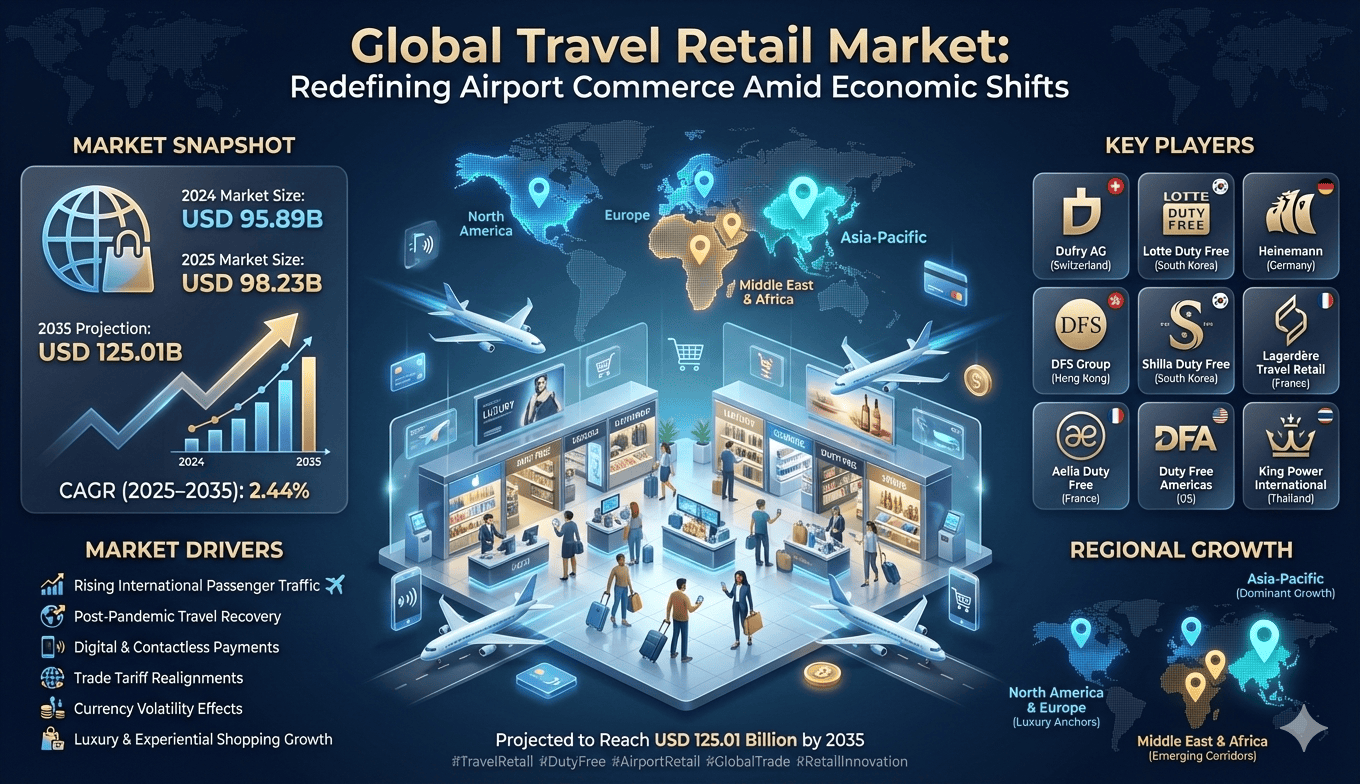
The global defense landscape continues to shape international commerce corridors, and nowhere is this more evident than in the Travel Retail Market, which stands at a critical juncture amid evolving geopolitical complexities. The Travel Retail Market was valued at USD 95.89 billion in 2024 and is projected to reach USD 98.23 billion in 2025, demonstrating resilience despite mounting global challenges. By 2035, the market is expected to expand to USD 125.01 billion, growing at a compound annual growth rate (CAGR) of 2.44% during the forecast period from 2025 to 2035. This sector encompasses duty-free shops, airport retail outlets, cruise ship stores, and border retail operations that cater to international travelers seeking premium products at tax-advantaged prices.
The competitive landscape features prominent players strategically positioned across major travel hubs worldwide. Dufry AG (Switzerland) leads the market with its extensive network spanning multiple continents, while Lotte Duty Free (South Korea) and Heinemann (Germany) maintain strong regional presences. DFS Group (Hong Kong), a subsidiary of luxury conglomerate LVMH, dominates the premium segment, particularly in Asia-Pacific locations. Shilla Duty Free (South Korea) and Lagardère Travel Retail (France) have established significant footprints in high-traffic airports and travel terminals. Additional key players including Aelia Duty Free (France), Duty Free Americas (United States), and King Power International (Thailand) continue expanding their operational reach through strategic partnerships with airport authorities and cruise line operators, creating a highly competitive environment driven by exclusive concession agreements and evolving consumer expectations.
Regional dynamics reveal distinct growth patterns and market characteristics across global territories. The Asia-Pacific region commands the largest market share, driven by rising disposable incomes, expanding middle-class populations, and increasing international travel from China, India, and Southeast Asian nations. Europe maintains substantial market presence through established travel retail infrastructure at major hub airports like London Heathrow, Paris Charles de Gaulle, and Frankfurt, where luxury brands and cosmetics dominate sales. North America exhibits steady growth supported by cross-border shopping between the United States and Canada, alongside strong cruise ship retail operations in Caribbean routes. The Middle East and Africa region shows promising potential, particularly through Dubai International Airport’s position as a global transit hub, though recent geopolitical tensions have introduced volatility. South America presents emerging opportunities as travel infrastructure improves and regional air travel expands, though economic fluctuations impact consumer spending patterns.
Access Free Sample Copy – https://www.marketresearchfuture.com/sample_request/11814
Segmentation analysis reveals the market’s multifaceted structure across several dimensions. By product category, perfumes and cosmetics constitute the largest segment, followed by wines and spirits, fashion accessories, electronics, confectionery, and tobacco products. The sales channel segmentation distinguishes between airport retail, which dominates with the highest transaction volumes, alongside cruise ferry retail, airline retail, and border shops. Customer type classification separates business travelers, who typically spend more per transaction on premium products, from leisure travelers who focus on gifts and personal indulgences. Packaging type considerations increasingly emphasize sustainable and premium packaging as environmental consciousness and brand perception influence purchasing decisions across demographic segments.
Several driving factors propel market expansion despite modest growth rates. The resumption of international travel following pandemic restrictions has reinvigorated passenger traffic through major airports and cruise terminals. Growing affluence in emerging markets, particularly among Asian middle-class consumers, increases demand for luxury goods and international brands at duty-free prices. Airport modernization projects and expansion of retail spaces create enhanced shopping environments with improved customer experiences. Strategic brand partnerships between retailers and luxury houses ensure exclusive product offerings and limited editions that attract discerning travelers. Digital transformation initiatives, including mobile payment solutions, pre-order services, and personalized marketing through data analytics, enhance convenience and drive conversion rates.
Current trends reshaping the industry include the integration of omnichannel retail strategies that blend physical stores with online platforms, allowing travelers to browse products digitally and collect them at airports. Experiential retail concepts replace traditional shop formats, featuring interactive brand installations, tasting lounges, and cultural showcases that transform shopping into entertainment. Sustainability initiatives gain prominence as consumers demand eco-friendly products and retailers adopt circular economy principles, reducing plastic packaging and carbon footprints. Local and artisanal products increasingly complement international luxury brands, catering to travelers seeking authentic regional items. Personalization through AI-driven recommendations and loyalty programs creates tailored shopping experiences that enhance customer engagement and spending.
Access Full Report – https://www.marketresearchfuture.com/reports/travel-retail-market-11814
The escalating conflict involving Iran, Israel, and USA involvement directly impacts the Travel Retail Market through multiple transmission channels. Military tensions surrounding the Strait of Hormuz and broader Middle East instability suppress international travel demand as tourists avoid regions perceived as dangerous, directly reducing passenger traffic through affected airports and cruise routes. Airlines reroute flights around conflict zones, eliminating lucrative transit stops at major Middle Eastern retail hubs that previously captured significant sales from connecting passengers. Insurance premiums surge for carriers operating in volatile regions, raising ticket prices and deterring discretionary travel. The psychological impact of sustained conflict creates broader travel anxiety, dampening global tourism even in unaffected regions as risk-averse consumers postpone international trips. Additionally, fuel price volatility stemming from Middle East supply concerns increases airline operating costs, potentially reducing flight frequencies and further constraining the traveler base for retail operations.
GLOBAL SUPPLY CHAIN & MARKET DISRUPTION ALERT
Escalating geopolitical tensions in the Middle East, particularly around the Strait of Hormuz and the Red Sea, are creating significant disruptions across global energy, chemicals, and logistics markets. Critical shipping corridors are under pressure, with major oil, LNG, petrochemical, and raw material flows at risk, triggering supply chain delays, freight cost surges, insurance withdrawals, and heightened price volatility. These disruptions are increasing operational risks and cost uncertainties for industries dependent on global trade routes and energy-linked feedstocks.
Frequently Asked Questions
Q1: How do currency fluctuations affect travel retail purchasing behavior?
Currency exchange rate volatility significantly influences traveler spending patterns in duty-free environments. When a traveler’s home currency strengthens against the local currency where shopping occurs, purchasing power increases, encouraging higher-value transactions and luxury goods acquisitions. Conversely, currency depreciation reduces affordability of premium international brands. Travel retailers often adjust pricing strategies dynamically based on currency movements and passenger origin mix, while some implement multi-currency pricing displays to help shoppers identify value opportunities. Cryptocurrency payment adoption is emerging as a potential solution to currency volatility concerns among international travelers.
Q2: What role do airport concession agreements play in market competition?
Airport concession agreements represent the foundational structure governing travel retail operations, typically awarded through competitive bidding processes where retailers secure exclusive rights to operate in specific terminal zones for defined periods, usually 5-10 years. These contracts require substantial upfront investments and guaranteed minimum annual revenues to airport authorities, creating significant barriers to entry. Concession terms dramatically influence retailer profitability through rent structures calculated as percentages of sales, space allocation that determines product category mix, and passenger traffic guarantees. Strategic positioning within terminals—proximity to boarding gates versus arrival halls—affects foot traffic and sales performance, making concession location negotiation critical to competitive advantage and long-term success in this concentrated market.
Read Our Related Report:
Incentive Travel Market –
https://www.marketresearchfuture.com/reports/incentive-travel-market-33762
Travel Trailers Sector Analysis Forecast Market –
https://www.marketresearchfuture.com/reports/travel-trailers-sector-analysis-forecast-market-36682
US Travel Retail Market –
https://www.marketresearchfuture.com/reports/us-travel-retail-market-20937
Ski Gear And Equipment Market –
https://www.marketresearchfuture.com/reports/ski-gear-and-equipment-market-41844
E-Retail Market –
https://www.marketresearchfuture.com/reports/e-retail-market-41602