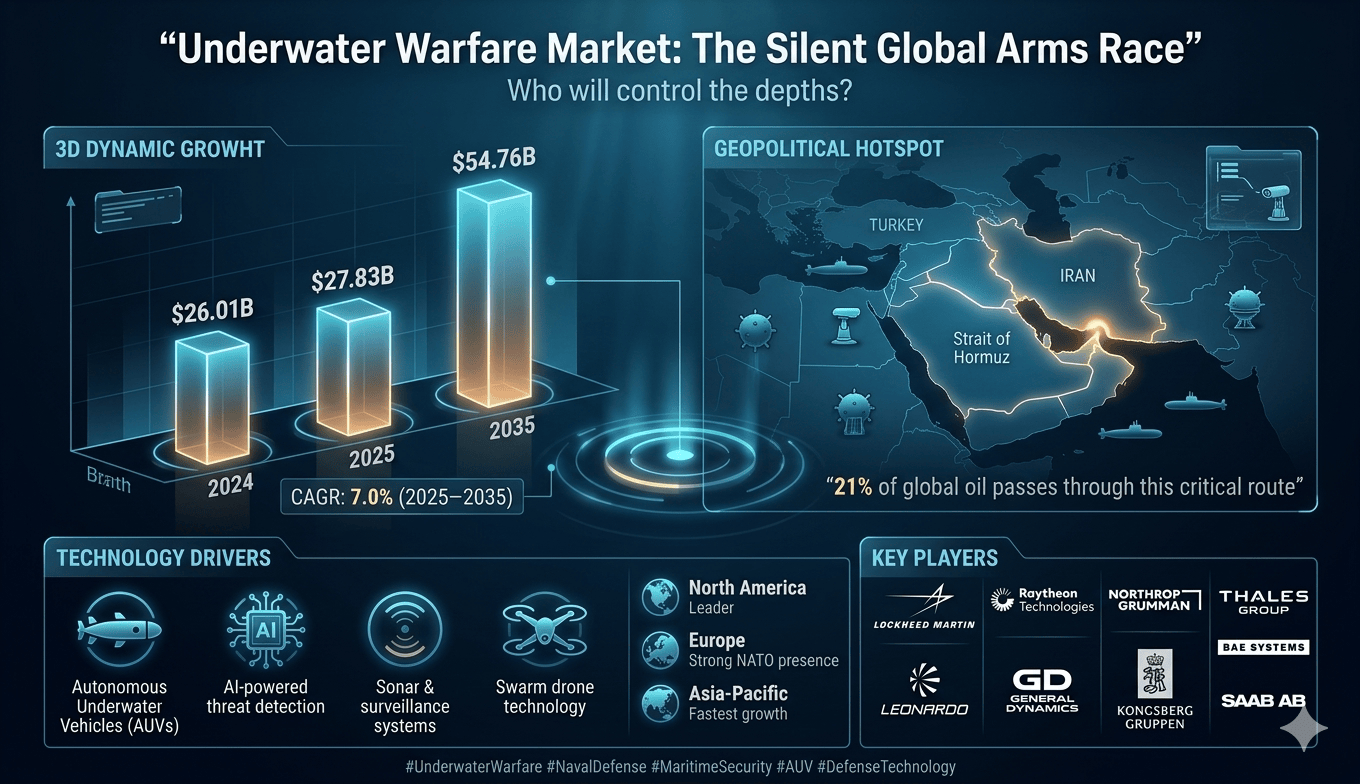
The global Underwater Warfare Market was valued at USD 26.01 billion in 2024 and is projected to grow from USD 27.83 billion in 2025 to USD 54.76 billion by 2035, registering a robust Compound Annual Growth Rate (CAGR) of 7.0% during the forecast period from 2025 to 2035. This significant expansion reflects a global surge in defense modernization efforts, escalating maritime security threats, and an accelerating shift toward next-generation submarine and underwater combat technologies. Nations across the world are channeling substantial investments into advanced underwater systems to establish and maintain maritime dominance, reinforcing the market’s upward trajectory over the next decade.
Key Market Players
The underwater warfare landscape is shaped by a handful of dominant defense contractors and technology firms. Key companies profiled in the market include Lockheed Martin, Raytheon Technologies, Northrop Grumman, and General Dynamics from the United States; Thales Group from France; BAE Systems from the United Kingdom; Leonardo from Italy; Kongsberg Gruppen from Norway; and Saab AB from Sweden. These industry leaders are continuously investing in research and development to deliver superior sonar systems, torpedo technologies, mine countermeasure solutions, and autonomous platforms. The competitive landscape is characterized by strategic partnerships, government contracts, and a relentless focus on integrating artificial intelligence and advanced sensor technologies into underwater warfare platforms.
Regional Analysis
Geographically, the underwater warfare market is analyzed across North America, Europe, Asia-Pacific (APAC), South America, and the Middle East and Africa (MEA). North America leads the global market, underpinned by the United States’ massive defense budget and strategic naval investments. The U.S. Navy’s ongoing submarine fleet expansion programs and its focus on anti-submarine warfare (ASW) capabilities ensure continued market dominance in this region.
Europe holds a significant share owing to heightened threat perceptions from geopolitical developments in Eastern Europe. Nations such as the United Kingdom, France, Germany, and Norway are scaling up their underwater defense capabilities, with NATO’s collective defense posture further amplifying procurement activities. The Asia-Pacific region is expected to register the fastest growth rate during the forecast period, driven by escalating maritime territorial disputes in the South China Sea, rapid naval modernization programs in China, India, South Korea, Japan, and Australia, and the growing presence of submarines and underwater drones in regional naval arsenals. Meanwhile, South America and the MEA regions are steadily increasing defense expenditures, though they represent smaller yet growing segments of the global market
Access Free Sample Copy –
https://www.marketresearchfuture.com/sample_request/21884
Segmentation Analysis
The underwater warfare market is segmented by System, Capability, Platform, and Region. By system, the market encompasses submarine combat systems, torpedoes, sonar systems, mine countermeasure systems, and unmanned underwater vehicles (UUVs). The UUV segment is gaining rapid traction due to advancements in autonomous propulsion, energy storage, and onboard sensor suites that enable prolonged underwater missions without human intervention.
By capability, the market covers anti-submarine warfare (ASW), anti-surface warfare, mine warfare, and intelligence, surveillance, and reconnaissance (ISR). ASW remains the dominant capability segment as navies worldwide prioritize detecting and neutralizing adversarial submarines. By platform, the market is segmented into submarines, surface ships, unmanned underwater vehicles, and helicopters. Submarines represent the highest-value platform segment, with nuclear-powered variants accounting for a disproportionate share of procurement expenditure. Autonomous underwater platforms, however, are the fastest-growing segment, as they offer cost-effective and risk-free alternatives for mine detection, ISR, and littoral combat missions.
Growth Factors and Market Trends
Several macro and technological factors are propelling the underwater warfare market forward. A primary growth driver is the rapid advancement in autonomous underwater vehicles (AUVs), which have become central to modern naval strategies. AUVs are increasingly deployed for mine countermeasures, seabed mapping, anti-submarine reconnaissance, and covert surveillance, significantly expanding operational capabilities without jeopardizing human lives. Technological breakthroughs in machine learning and edge computing are enabling AUVs to process complex data in real time and execute mission-critical decisions autonomously.
Another pivotal trend is the integration of artificial intelligence and big data analytics into underwater combat management systems. Modern sonar arrays equipped with AI-driven signal processing can distinguish between friendly and hostile underwater signatures with greater precision and speed. Additionally, the development of hypersonic underwater missiles and advanced torpedo guidance systems is reshaping strategic deterrence at sea. Nations are also investing heavily in directed energy weapons and electromagnetic systems designed for underwater deployment, adding a new dimension to undersea combat. Growing investments in cyber resilience for underwater communication networks are also a key focus area, as modern submarines and UUVs rely on encrypted acoustic communication links that must remain impenetrable to adversarial interception.
Global Supply Chain & Market Disruption Alert: Impact of Geopolitical Conflicts
Escalating geopolitical tensions — particularly the ongoing conflicts in Eastern Europe and the Middle East — are having a profound and multifaceted impact on the underwater warfare market. The Russia-Ukraine conflict has heightened NATO nations’ urgency to bolster their underwater naval capabilities, prompting emergency procurement of submarines, ASW helicopters, and maritime surveillance systems. Black Sea operations have demonstrated the critical importance of mine warfare and coastal defense systems, accelerating procurement timelines across European navies.
Simultaneously, instability around the Strait of Hormuz and the Red Sea is disrupting global shipping lanes, raising the operational urgency for underwater patrol and interdiction capabilities. Critical shipping corridors are under threat, with significant oil, LNG, petrochemical, and raw material flows at risk — triggering supply chain delays, freight cost surges, insurance withdrawals, and heightened price volatility. These disruptions are compounding operational risks and cost uncertainties for defense contractors dependent on global supply chains for rare-earth materials, semiconductors, and advanced composites used in underwater weapons systems. Furthermore, heightened threat perceptions in the Indo-Pacific — fueled by tensions in the South China Sea and around Taiwan — are driving unprecedented naval build-ups, with multiple APAC nations accelerating submarine acquisition programs and UUV fleet expansions. Collectively, these conflict dynamics are serving as a powerful stimulus for global underwater warfare market growth, even as they complicate supply chain management for defense manufacturers.
Access Full Report –
https://www.marketresearchfuture.com/reports/underwater-warfare-market-21884
Key Market Opportunities
The most significant market opportunity lies in the rapid commercialization and military adoption of advanced autonomous underwater vehicles. Governments are increasingly funding AUV development programs as force multipliers, with the potential to deploy large swarms of low-cost UUVs to overwhelm adversarial defenses. The integration of AI-powered navigation, advanced battery technology including lithium-sulfur chemistries, and underwater wireless communication protocols such as acoustic modems and optical communications is expected to dramatically extend mission endurance and operational range for next-generation UUVs. The development of undersea data networks and seabed surveillance infrastructure also represents a lucrative growth avenue, as nations seek persistent maritime domain awareness in strategically vital ocean regions.
The modernization of submarine fleets across both nuclear and conventionally powered variants continues to generate sustained procurement demand. Programs such as AUKUS, France’s Barracuda-class nuclear submarines, and India’s Project 75I advanced submarine program are indicative of the multi-billion-dollar investments being made globally. These programs encompass not only the platforms themselves but also the full array of associated weapons, sensors, and electronic warfare systems, creating extensive opportunities across the market’s entire value chain.
Frequently Asked Questions (FAQs)
Q1: How is artificial intelligence transforming underwater mine countermeasure (MCM) operations?
AI is fundamentally reshaping MCM operations by enabling autonomous underwater vehicles to detect, classify, and neutralize sea mines with minimal human supervision. Advanced machine learning algorithms allow AUVs to process sonar data and distinguish between mine-like objects and natural seabed features with high precision. This capability reduces risk to human divers and manned vessels while drastically shortening mine clearance timelines. Nations are increasingly adopting AI-driven MCM systems as a cornerstone of their littoral warfare strategies, which is expected to be a major long-term growth catalyst for the underwater warfare market.
Q2: What role does the AUKUS trilateral security pact play in shaping the future of the underwater warfare market?
The AUKUS pact, comprising Australia, the United Kingdom, and the United States, represents one of the most consequential defense agreements of the 21st century for undersea warfare. Under the agreement, Australia is set to acquire nuclear-powered submarines with the support of the U.S. and UK, fundamentally shifting the naval balance in the Indo-Pacific. Beyond submarines, AUKUS encompasses deep cooperation on advanced autonomous systems, AI integration in undersea warfare, quantum sensing for underwater detection, and hypersonic weapons. The pact is expected to generate hundreds of billions of dollars in underwater defense procurement over the coming decades, creating significant long-term demand for key players in the global underwater warfare market.
Read Our Related Report:
Anti Submarine Warfare Market Research Report –
https://www.marketresearchfuture.com/reports/anti-submarine-warfare-market-23768
Fire Department Software Market Research Report –
https://www.marketresearchfuture.com/reports/fire-department-software-market-23868
Electronic Warfare Aircraft Market Research Report –
https://www.marketresearchfuture.com/reports/electronic-warfare-aircraft-market-29522
Airborne Situational Awareness System Market Research Report –
https://www.marketresearchfuture.com/reports/airborne-situational-awareness-system-market-33850
Littoral Warship Market Research Report –
https://www.marketresearchfuture.com/reports/littoral-warship-market-40350
Source: Market Research Future | Report Coverage: Revenue Forecast, Competitive Landscape, Growth Factors, and Trends | Historical Data: 2019–2024 | Forecast Period: 2025–2035